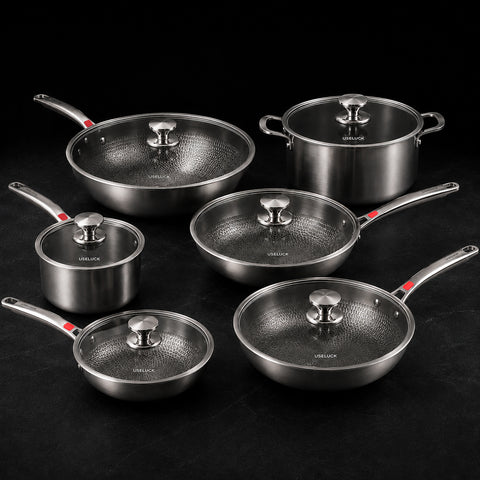
Titanium cookware is attracting home cooks who want a durable, lightweight alternative to traditional nonstick pans. But the word “titanium” does not always tell the full story. One pan may be solid titanium, another may use titanium only on the food-contact surface, and a third may contain titanium particles inside a conventional nonstick coating.
Those products are not the same. Before choosing a titanium frying pan, it is important to know what actually touches your food, whether a synthetic coating is present, how the pan handles heat, and what any laboratory testing truly confirms.
Titanium is a strong, lightweight and corrosion-resistant metal. In cookware, it may be used as the main pan material, as the cooking surface, or as an ingredient added to another coating.
Seeing “titanium” on a product page does not automatically mean the entire pan is pure titanium. It also does not guarantee that the pan is uncoated. The most useful question is:
What material directly touches my food?
A trustworthy cookware brand should answer that clearly instead of relying on vague terms such as “titanium technology” or “titanium infused.”
Titanium cookware generally falls into three categories.
Here, the pan body is made primarily from titanium. This construction can be very light and resistant to corrosion, which is why it is common in outdoor cookware. However, titanium alone does not spread heat as quickly as some other cookware metals. A thin solid-titanium pan may develop hotter and cooler areas, so thickness, shape and cooking technique matter.
This construction places titanium on the surface that directly touches food and pairs it with an overall pan structure designed to support heat performance, strength and cooktop compatibility.
This is the category USELUCK belongs to. USELUCK uses a pure, uncoated titanium cooking surface with a micro-hammered texture. The food-contact surface is not a conventional sprayed-on nonstick coating. Its overall cookware construction is designed for responsive, even cooking on gas, electric, ceramic and induction cooktops.
Some pans use a traditional nonstick coating reinforced with titanium particles. Titanium may help strengthen the coating, but the cooking surface is still a coating and its lifespan still depends on that layer. “Titanium reinforced” should not be confused with an uncoated titanium surface.
Titanium is valued for corrosion resistance and stability during normal food-contact use. It is also suitable for acidic ingredients such as tomatoes, citrus and vinegar without the seasoning concerns associated with some reactive cookware surfaces.
Cookware safety, however, should not be judged by one material name alone. Buyers should consider the entire product: the food-contact surface, any coatings, manufacturing quality, handles, temperature limits and available test documentation.
With USELUCK, food directly contacts a pure titanium surface. There is no synthetic nonstick, PTFE-based or ceramic coating on that surface to peel, chip or wear away. Normal cooking and care instructions should still be followed for the best performance and long-term appearance.
Sometimes—but not always. A titanium-reinforced pan may still rely on a synthetic nonstick coating. The USELUCK cooking surface is different: it is uncoated titanium.
Its food-release performance comes from the engineered cooking surface, micro-hammered texture, oil distribution and proper heat control—not from a temporary sprayed-on layer. For best results, preheat gently over low to medium heat, add a small amount of oil, and wait until food releases naturally before flipping. If food resists, it often needs another moment to finish searing.
An uncoated titanium pan should not be described as identical to a new PTFE-coated pan.
An uncoated titanium surface has no synthetic nonstick layer to peel or chip. The material touching your food remains clearly identified.
Titanium is known for strength and everyday scratch resistance. USELUCK pans are designed for normal use with metal utensils. Still, no cookware is completely scratch-proof, so avoid cutting food directly inside the pan or striking the surface with excessive force.
Durable cookware does not need to be difficult to lift. The USELUCK 12-inch titanium frying pan weighs approximately 2.4 pounds, making it easier to move between the stovetop, oven and table than many heavy pans.
Titanium resists rust and corrosion in everyday cooking. It does not require cast-iron-style seasoning and can be used with acidic foods.
USELUCK titanium cookware works on gas, electric, ceramic and induction cooktops. The 12-inch pan is oven safe up to 750°F. Always check the specific product page because lids and accessories may have different limits.
Because the cooking surface does not depend on a synthetic nonstick coating, there is no conventional coating that gradually wears away. Good cooking habits and proper care still matter, but the titanium surface is made for lasting everyday use.
An uncoated titanium pan requires some heat control. Starting too hot, using no oil, or flipping food immediately may cause sticking. Low to medium heat is enough for most everyday meals.
Titanium itself is not the fastest heat-spreading metal, so the performance of a titanium frying pan depends on its complete construction—not just the word “titanium.” Also remember that scratch resistant does not mean indestructible: knives, abrasive cleaners and excessive force can still mark a surface.
A credible third-party report should identify the tested sample, method, conditions, date and result. Depending on the test, it may help verify material composition, food-contact migration, corrosion behavior or antibacterial performance.
USELUCK highlights third-party laboratory testing for specified product claims. That evidence should be read according to the report’s scope. For example, an antibacterial-performance test does not mean normal kitchen hygiene is unnecessary or that every titanium product performs identically.
Before relying on a report, ask whether the actual finished cooking surface was tested, which method was used, what conditions were included, and whether the result supports the exact claim being made. Transparent evidence is more valuable than a laboratory logo shown without context.
Use this checklist:
Food-contact material: Is it pure titanium, an alloy or a titanium-reinforced coating?
Coating disclosure: Is there a synthetic or ceramic nonstick layer?
Construction: How is the pan designed to distribute heat?
Compatibility: Does it work on your cooktop?
Temperature limits: Are the pan, lid and handle rated equally?
Testing: What do the laboratory reports actually verify?
Technique: Does the brand provide honest cooking instructions?
Support: Is there a clear return policy?
Titanium cookware can be worth the investment for cooks who want a lightweight, corrosion-resistant pan without a conventional synthetic nonstick coating. It is especially appealing to households tired of replacing coated pans as their surfaces wear down.
It may not suit someone expecting completely oil-free cooking with no learning curve. An uncoated surface rewards three simple habits: gentle preheating, a little oil and patience before flipping.
USELUCK was created around that balance—a pure titanium food-contact surface, an engineered pan construction and a micro-hammered texture designed for confident everyday cooking and natural food release without a synthetic nonstick layer.
USELUCK describes the material directly touching food as a pure, uncoated titanium cooking surface. We do not use “100% pure titanium” to imply that every component of the pan is made from one material.
USELUCK does not use a synthetic nonstick coating. Its micro-hammered surface supports natural food release with gentle preheating, a small amount of oil and enough time for food to release before flipping.
Yes. USELUCK titanium cookware is designed for gas, electric, ceramic and induction cooktops.
Yes, for normal cooking. Avoid cutting food directly in the pan or using excessive force.
Let the pan cool, then use warm soapy water and a non-abrasive sponge. Soak stubborn residue first and avoid placing a very hot pan under cold water.
Ordinary titanium can show visible color changes after overheating. USELUCK is designed to resist everyday staining and heat discoloration, but an empty pan should not be left over high heat for an extended period.
Understanding the food-contact surface, full construction and correct cooking method makes it easier to choose cookware with confidence.
Discover how USELUCK titanium cookware is made.
For best results, also read our five-step titanium cooking guide.